


Principles of Specifying a Program Trajectory by N-Focal Curves
https://doi.org/10.21821/2309-5180-2025-17-6-873-883
EDN: ISZLBC
Abstract
The article proposes an approach to improving the use of isostages through their generalized representation when specifying a vessel’s program trajectory under conditions of restricted navigation. It is assumed that the principle of automatic tracking of multiple navigational marks by onboard navigational aids has been implemented. Based on previous research, the feasibility of approximating the boundaries of navigational hazards and the navigational safety domain by N-focal ellipses is substantiated. It has been shown that second-order N-focal curves allow for a more accurate approximation of the geometric shapes of navigational hazards without significant overlap of possible vessel maneuvering areas, while being directly associated with navigational parameters measured by onboard technical navigational aids and therefore independent of global satellite positioning systems. In this study, further development is proposed by representing isolines of navigational parameters using a generalized second-order N-focal curve. For this purpose, the concept of weight is introduced, which, under certain combinations, makes it possible to obtain an entire family of second-order curves (circles, ellipses, hyperbolas, N-focal ellipses, and N-focal hyperbolas) while keeping the initial measurements unchanged. Taking into account the specific arrangement of reference navigational marks, the affine transformation method is supplemented by variations in the base length between the reference marks. This approach makes it possible, for example, at the preliminary route planning stage, to obtain a complete grid of leading, clearing, and control isolines for a given program trajectory and its corridor in the form of second-order curves. The key results of the study are visualized, and the implementation of the proposed methods in modern navigation systems and autonomous vessel control systems will enable navigation information processing in coastal waters at a qualitatively new level.
About the Author
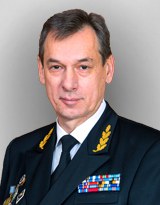
A. A. Mironenko
Admiral Makarov State University of Maritime and Inland Shipping
Russian Federation
Russian Federation
Mironenko, Aleksandr A. — Grand PhD in Technical Sciences, associate professor
5/7 Dvinskaya Str., St. Petersburg, 198035
References
1. Dyda, A. A., I. I. Pushkarev and K. N. Chumakova. “Static obstacles avoidance algorithm for unmanned ship.” Vestnik gosudarstvennogo universiteta morskogo i rechnogo flota im. admirala S. O. Makarova 13.3 (2021): 307–315. DOI: 10.21821/2309-5180-2021-13-3-307-315.
2. Korenev, A. S., S. P. Khabarov and A. G. Shpektorov. “A route calculation for unmanned vessel .” Marine intellectual Technologies 4–1(54) (2021): 158–165. DOI: 10.37220/MIT.2021.54.4.047.
3. Mironenko, A. A. Formirovanie marshruta sudna v avtomatizirovannykh navigatsionnykh kompleksakh. PhD diss. Novorossiysk, 2002.
4. Barakat, L. A. and I. Yu. Kvyatkovskaya. “Planning safe routes for unmanned vessels based on artificial intelligence methods.” Vestnik of Astrakhan State Technical University. Series: Management, Computer Science and informatics 3 (2023): 46–54. DOI: 10.24143/2072-9502-2023-3-46-54.
5. Karetnikov, V. V., S. V. Kozik and A. A. Butsanets. “Risks assessment of applying unmanned means of water transport in the water area.” Vestnik gosudarstvennogo universiteta morskogo i rechnogo flota im. admirala S. O. Makarova 11.6 (2019): 987–1002. DOI: 10.21821/2309-5180-2019-11-6-987-1002.
6. Vas’kov, A. S. and A. A. Mironenko. “Method of no-go area fencing lines planning in vessel traffic control systems.” Marine intellectual Technologies 3–1(61) (2023): 110–119. DOI: 10.37220/MIT.2023.61.3.036.
7. Vas’kov, A. S. and A. A. Mironenko. “The multifocal ellipse ship’s domain model.” Marine intellectual Technologies 4–1(66) (2024): 259–266. DOI: 10.37220/MIT.2024.66.4.031.
8. Vincze, P. Erdös I. “On the Approximation of Convex, Closed Plane Curves by Multifocal Ellipses.” Journal of Applied Probability 19.A (1982): 89–96.
9. Melzak, Z. A. and J. S. Forsyth Polyconics 1: Polyellipses and optimization. Quart. Appl. Math. 35 (1977): 239–255.
10. Nie, J., P. A. Parrilo. and B. Sturmfels. “Semidefinite Representation of the k-Ellipse.” Algorithms in Algebraic GeometrySpringer New York, 2008: 117–132. DOI: 10.1007/978-0-387-75155-9_7.
11. Petrovic, M., B. Banjac and B. Malesevic. “The geometry of trifocal curves with applications in architecture, urban and spatial planning.” Spatium 32 (2014): 28–33. DOI: 10.2298/spat1432028p.
12. Sekino, J. “n-Ellipses and the Minimum Distance Sum Problem.” The American Mathematical Monthly 106.3 (1999): 193–202. DOI: 10.1080/00029890.1999.12005030.
13. Rakcheeva, T. A. “Fokusnaya approksimatsiya gladkikh geometricheskikh form.” Aktual’nye nauchnye problemy prikladnykh i estestvennykh nauk: Sbornik nauchnykh trudov kafedry prikladnoy matematiki i programmirovaniya Moskva: Federal’noe gosudarstvennoe byudzhetnoe obrazovatel’noe uchrezhdenie vysshego obrazovaniya “Rossiyskiy gosudarstvennyy universitet imeni A. N. Kosygina (Tekhnologii. Dizayn. Iskusstvo)», 2018: 188–202.
14. Kostyukov, V. A., M. Yu. Medvedev and V. Kh. Pshikhopov. “An algorithm for path planning in a twodimensional environment with polygonal obstacles on a class of piecewise polyline trajectories.” Izvestiya Sfedu. Engineering Sciences 5(235) (2023): 34–48. DOI: 10.18522/2311-3103-2023-5-34-48.
15. Plavnik, A. G. “Generalized spline-approximation problem formulation for spatial data modeling in geosciences.” Russian Geology and Geophysics 51.7 (2010): 1027–1037.
16. Yuyukin, I. V. “Generalization of the underwater relief image using the spline approximation method on a vector electronic chart.” Vestnik gosudarstvennogo universiteta morskogo i rechnogo flota im. admirala S. O. Makarova 16.6 (2024): 910–934. DOI: 10.21821/2309-5180-2024-16-6-910-934.
17. Zhu, W. and G. Qiu. “Path Planning of Intelligent Mobile Robots with an Improved RRT Algorithm.” Applied Sciences 15.6 (2025). DOI: 10.3390/app15063370.
Review
For citations:
Mironenko A.A. Principles of Specifying a Program Trajectory by N-Focal Curves. Vestnik Gosudarstvennogo universiteta morskogo i rechnogo flota imeni admirala S. O. Makarova. 2025;17(6):873-883. (In Russ.) https://doi.org/10.21821/2309-5180-2025-17-6-873-883. EDN: ISZLBC
Views:
318
JATS XML



 Email this article